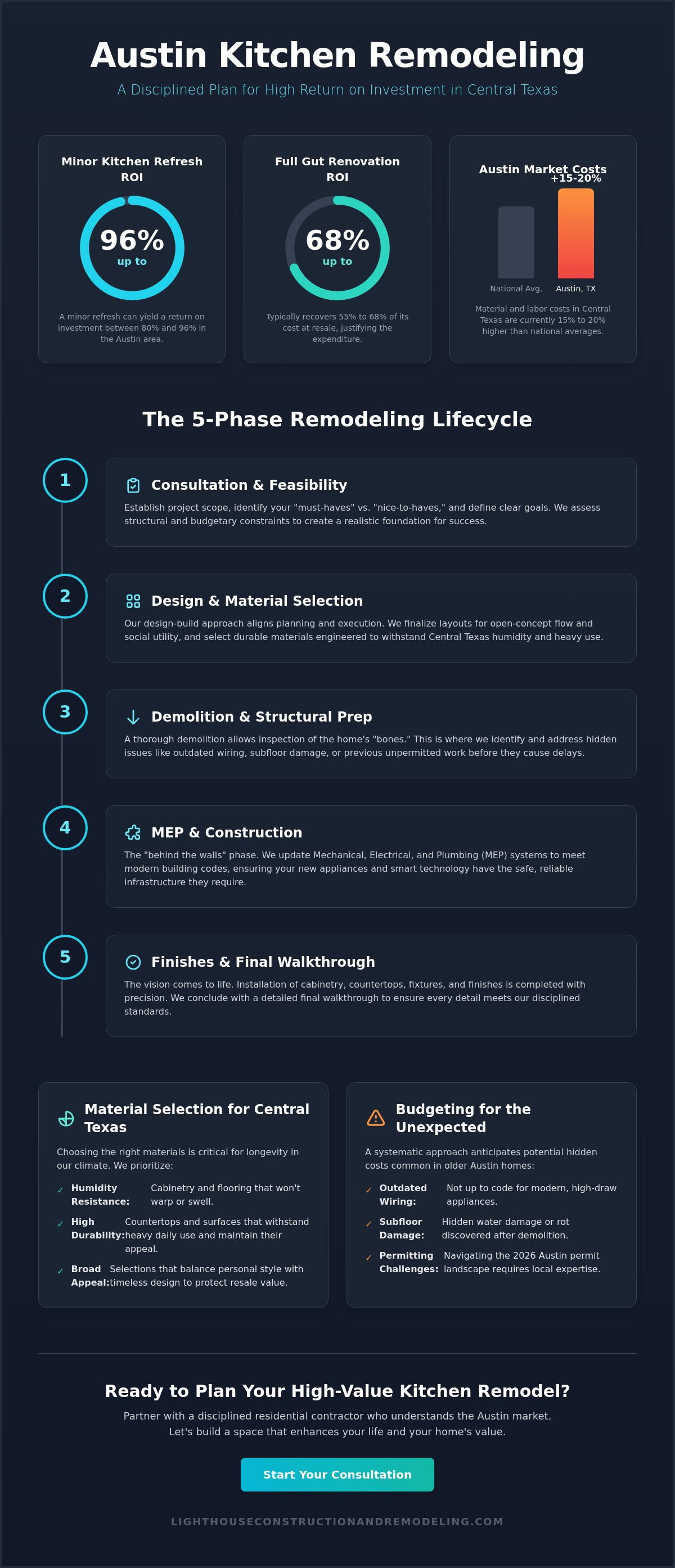
Did you know that a minor kitchen refresh in Austin can yield a return on investment as high as 96%, even though local labor and material costs are currently 20% higher than the national average? It's a striking statistic that highlights why a successful kitchen remodeling project requires more than just a vision; it requires a disciplined plan. Most homeowners we speak with are rightfully concerned about budget creep, the disruption to their daily lives, and the fear of hiring a contractor who lacks transparency.
We understand that the process feels overwhelming, especially when you're trying to choose materials that will withstand the Central Texas humidity without sacrificing style. This guide offers a transparent, step-by-step framework designed to help you plan and execute a high-value remodel with confidence. You'll learn how to navigate the 2026 Austin permit landscape, understand the ROI of specific upgrades, and manage the construction phase without the typical industry stress. By the end of this article, you'll have a clear roadmap to a functional, beautiful kitchen that increases your home's value.
Key Takeaways
- Understand why modern kitchen renovations in Austin prioritize social utility and open-concept flow to maximize both daily enjoyment and long-term resale value.
- Learn how an integrated design-build framework streamlines kitchen remodeling by aligning the planning and execution phases to prevent common project delays.
- Discover the most durable material choices for Central Texas homes, including how to select cabinetry and countertops that withstand local humidity and heavy use.
- Identify potential hidden costs, such as outdated wiring or subfloor damage, and learn how a systematic approach to budgeting ensures financial predictability.
- Find out how to partner with a disciplined residential contractor who understands the specific logistical and permitting requirements of the Austin and Central Texas market.
Kitchen Remodeling in Austin: Balancing Lifestyle and Long-Term Value
Deciding to invest in kitchen remodeling is often the most impactful financial decision an Austin homeowner can make. Recent data from February 2026 indicates that a minor kitchen refresh in our region can yield a return on investment between 80% and 96%. Even a full gut renovation typically recovers 55% to 68% of its cost at resale. These figures reflect the kitchen's role as the emotional and social heart of the home. While material and labor costs in Central Texas are currently 15% to 20% higher than national averages, the equity gained often justifies the expenditure. When you assess your current space, you likely notice friction points like cramped walkways or a lack of storage that hinders your daily routine. Addressing these issues isn't just about aesthetics; it's about reclaiming the utility of your home.
It's helpful to start by understanding the renovation process and how it differs from a simple cosmetic update. A cosmetic refresh might involve painting cabinets and updating hardware, while a structural renovation could involve removing load-bearing walls to create the open-concept layout that Austin buyers prize. Modern life in Central Texas often revolves around the kitchen as a multi-functional hub for cooking, remote work, and hosting friends. If your kitchen feels isolated from the rest of the living area, a structural change might be the necessary solution to align your home with current lifestyle demands and the social utility expected in modern floor plans.
Defining Your Remodeling Goals
Successful projects begin with a clear distinction between "must-haves" and "nice-to-haves." For growing families, this often means prioritizing durable surfaces and expanded pantry space. If you're planning for the long term, future-proofing through accessible design ensures the space remains functional as your needs change over time. We encourage homeowners to balance their unique personal style with choices that maintain broad appeal. This disciplined approach ensures that your kitchen remodeling project serves your current needs while protecting your future resale value.
The Central Texas Real Estate Context
The local real estate market varies significantly between neighborhoods. In growing areas like Cedar Park and Buda, a high-quality kitchen is often the deciding factor for buyers choosing between similar properties. In San Marcos, modernizing an outdated space is essential to remain competitive against the influx of newer builds. However, it's vital to evaluate your project against neighborhood standards. Over-improving a home beyond what the local market can support may limit your eventual ROI. We focus on helping you find that equilibrium where your investment matches the expectations of your specific community.
The Anatomy of a Modern Kitchen Renovation: A Systematic Approach
Successful kitchen remodeling is rarely the result of spontaneous decisions or the "TV magic" seen on home improvement networks. It is a methodical project management exercise that requires a disciplined, integrated system. By adopting a design-build philosophy, we ensure that the planning and execution phases are never decoupled. This integration prevents the common industry pitfall where a beautiful design is drafted only to be found structurally impossible or financially unfeasible during construction. When design and craftsmanship work in tandem, the result is a predictable process and a kitchen that functions as well as it looks.
The process begins long before the first cabinet is removed. A thorough demolition and structural assessment allow us to inspect the "bones" of your home. In older Austin properties, this phase often reveals hidden challenges like outdated wiring or previous unpermitted work. Addressing these issues early is essential for preparing a stable foundation for your new space. Once the site is cleared, we move into the mechanical, electrical, and plumbing (MEP) updates. This "behind the walls" phase is where your home is brought up to the 2021 International Building Code standards, ensuring your new appliances and smart technology have the infrastructure they need to operate safely.
The 5-Phase Remodeling Lifecycle
- Phase 1: Consultation and Feasibility. We establish the project scope and identify any potential structural or budgetary constraints.
- Phase 2: Design and Material Selection. You receive professional guidance to select finishes that balance durability with your personal aesthetic.
- Phase 3: Pre-construction and Permitting. We navigate the Austin regulatory landscape, securing the Residential Express Permit ($87.49) and managing the Plan Review Application ($136.45) to ensure full compliance.
- Phase 4: Active Construction. Our team manages daily milestones, from MEP rough-ins to cabinetry installation, keeping the project on schedule.
- Phase 5: Final Finishing. Professional craftsmanship takes center stage as we install backsplashes, flooring, and fixtures to complete the vision.
Structural Integrity and Foundations
Central Texas is known for its volatile clay soil, which can wreak havoc on home stability. If your project involves home additions or expanding the kitchen's footprint, foundation health is the first priority. A specialized residential foundation contractor must evaluate the site to prevent future settling or cracking. We take a rigorous approach to structural changes, ensuring that every load-bearing wall removal is backed by professional engineering. This commitment to structural integrity is why a disciplined kitchen renovation contractor is vital for complex Austin projects. We don't just focus on the cabinets; we ensure the entire structure is prepared to support your investment for decades.
Material Selection for Central Texas Homes: Durability Meets Design
Selecting materials for your kitchen remodeling project requires a balance between aesthetic vision and the practical realities of the Austin climate. In Central Texas, high humidity and temperature fluctuations can impact how certain materials perform over time. We focus on helping you choose finishes that offer long-term stability without compromising on the modern look you desire. This selection process is about more than just matching colors; it is about ensuring that every component, from the counters to the cabinets, can withstand the rigors of an active household.
Countertop choices often come down to Quartz versus Granite. While Granite offers a classic, heat-resistant surface, Quartz has become the dominant choice for 2026 due to its non-porous nature and low maintenance requirements. It doesn't require the periodic sealing that natural stone needs, making it ideal for busy families. When it comes to cabinetry, which typically accounts for 30% to 40% of a kitchen budget, we are seeing a strong shift toward natural wood tones like white oak. Whether you choose custom or semi-custom construction, the quality of the hardware, such as soft-close hinges and heavy-duty drawer slides, is what ensures the kitchen remains functional for decades.
The Best Flooring for Central Texas Kitchens
Austin's humidity makes flooring selection particularly critical. While traditional hardwood remains popular, it can be prone to expansion and contraction in our climate. Many homeowners now opt for luxury vinyl plank (LVP) because it is entirely waterproof and highly resistant to scratches. If you prefer tile installation, the focus must be on the substrate and grout. Because of the heavy clay soil in our region, professional substrate preparation is necessary to prevent tiles from cracking as the home naturally shifts. We ensure your flooring is installed with the technical precision required for our local environment.
Sustainable and Smart Kitchen Features
Modern kitchens in Central Texas increasingly incorporate technology and eco-friendly materials. Energy-efficient appliances are a standard request to help manage utility costs during hot Texas summers. We also see a rise in smart home integration, such as touchless faucets and voice-controlled lighting layers that provide task, ambient, and accent illumination. For those prioritizing sustainability, recycled composite surfaces and low-VOC paints offer a way to create a beautiful space that is also environmentally responsible. These features aren't just trends; they are investments in the efficiency and health of your home.
Budgeting and Planning: Eliminating the Stress of Hidden Costs
Financial predictability is often the greatest concern for homeowners embarking on a kitchen remodeling journey. Most industry stress stems from a lack of clarity regarding where money is spent and why costs fluctuate during construction. We advocate for a structured fee model that provides transparency from the initial estimate through the final walkthrough. By establishing a clear financial framework early, we eliminate the adversarial relationship that often exists between homeowners and contractors. This approach ensures that your investment is managed with the same discipline as the physical construction itself.
Even with a methodical plan, the demolition phase can reveal unforeseen challenges. In Central Texas homes, common hidden costs include mold remediation from slow leaks, outdated electrical wiring that doesn't meet current safety standards, or subfloor damage caused by long-term moisture. We recommend setting aside a contingency fund of 10% to 15% of the total project cost. This isn't a suggestion to spend more; it's a strategic buffer that ensures your project doesn't stall if a structural surprise occurs behind the drywall. Having this reserve allows you to make decisions based on logic rather than panic.
Where to Invest vs. Where to Save
Smart budgeting requires prioritizing the "bones" of the kitchen. Investing in high-quality plumbing, electrical updates, and structural integrity provides a foundation that lasts for decades. These are the areas where cutting costs often leads to expensive repairs later. Conversely, you can save on aesthetics by choosing semi-custom cabinetry or selecting high-quality finishes that mimic luxury materials at a lower price point. Professional project management plays a vital role here, helping you navigate these choices to maximize value without compromising the home's safety or efficiency.
Avoiding Common Remodeling Mistakes
The most frequent budget killer in any renovation is a mid-project layout change. Moving a sink or a stove after the plumbing and electrical rough-ins are complete creates a cascade of additional labor and material costs. To prevent this, we insist on a comprehensive "Scope of Work" and detailed design approval before any physical work begins. It's also important to distinguish between a professional remodeling contractor and a general handyman. Large-scale projects require the systematic oversight that only a dedicated project management team can provide. For a predictable and managed construction process, you can start your kitchen remodeling project with a team that prioritizes financial integrity and thorough planning.
Partnering with a Trusted Kitchen Renovation Contractor in Central Texas
Lighthouse Construction and Remodeling focuses on residential excellence throughout the Austin metropolitan area and beyond. We believe that a successful partnership is built on a foundation of mutual trust and professional integrity. Our team specializes in residential projects, ensuring that every kitchen remodeling engagement receives our undivided attention and technical expertise. We manage projects across a wide geography, from the growing northern suburbs of Cedar Park down to the historic communities of New Braunfels. This broad reach allows us to bring a disciplined, systematic approach to homeowners throughout the entire Central Texas corridor.
Transparency serves as the core of our business model rather than just a marketing term. We avoid the high-pressure tactics common in the home improvement industry, opting instead to act as a steady, honest advisor throughout the construction lifecycle. Our commitment to your satisfaction doesn't end when the last cabinet is installed. We perform a rigorous final walkthrough to ensure every detail meets our high standards of craftsmanship. This methodical approach to the final stages of construction ensures that the transition back to your daily life is as smooth and predictable as the renovation itself.
Local Expertise from Kyle to Seguin
Executing projects in Hays and Comal counties requires a deep understanding of local building codes and specific permitting requirements. Our local presence in areas like Kyle and Seguin ensures that we can provide consistent site supervision and maintain efficient project timelines. We understand the specific logistical challenges of working in these communities, from managing local inspections to coordinating material deliveries. This community-focused approach allows us to build lasting relationships with our Texas neighbors while delivering results that respect the unique character of each locality. We take pride in being a local partner who understands the nuances of the Central Texas landscape.
Your Next Steps to a Dream Kitchen
Preparing for a renovation begins with clear communication and a shared vision. Before your initial consultation, we recommend identifying your primary goals and establishing a realistic budget range based on the local market factors we have discussed. Our role is to guide you through the complexities of the design-build process, ensuring that every decision is informed by data and professional expertise. Maintaining an open dialogue during the construction phase helps prevent misunderstandings and keeps the project moving forward predictably. If you're ready to transform your space, you can Schedule your transparent kitchen remodeling consultation today. Our team is prepared to help you navigate your project through a managed, ethical, and highly organized process.
Taking the First Step Toward Your New Kitchen
Transforming your home is a significant investment that deserves a disciplined, transparent approach. By prioritizing structural integrity and selecting materials suited for the Central Texas climate, you ensure that your kitchen remodeling project provides both immediate utility and long-term financial value. A successful renovation isn't just about the final design; it's about the systematic management of every detail from the first permit to the final walkthrough.
With over 10 years of residential expertise in Central Texas, Lighthouse Construction is here to act as your steady advisor. We specialize in complex kitchen and bathroom structural renovations, utilizing a proven project management system to eliminate the typical stresses of construction. We believe that clarity and integrity are the most important tools we bring to any job site. If you're ready to move forward with confidence, you can Start Your Transparent Kitchen Remodel Journey today. Your vision for a more functional and beautiful home is within reach, and we look forward to helping you build it with precision.
Frequently Asked Questions
How much does a kitchen remodel cost in the Austin area?
Mid-range projects in Austin typically range from $25,000 to $75,000, while high-end renovations can exceed $200,000. These figures reflect local market factors where labor and material costs are approximately 15% to 20% higher than national averages. Your final investment depends on material choices and whether you require structural changes to your home's footprint.
How long does a typical kitchen renovation take from start to finish?
Most projects require between 8 and 12 weeks for the active construction phase. This timeline doesn't include the initial 4 to 6 weeks needed for design, material procurement, and permitting. A disciplined project management system helps prevent common delays by ensuring all materials are on-site before demolition begins.
Do I need a permit for my kitchen remodel in Cedar Park or San Marcos?
Yes, you generally need permits in Cedar Park and San Marcos for any work involving electrical, plumbing, or structural changes. For example, the City of Austin charges a $166.99 electrical fee and a $200.43 plumbing fee for FY2026. While cosmetic updates like painting don't require them, any kitchen remodeling project that reconfigures infrastructure must comply with the 2021 International Building Code.
Can I stay in my home during a major kitchen renovation?
You can remain in your home, but you should prepare for significant disruption to your daily routine. Construction creates dust and noise, and you'll be without a functional kitchen for several weeks. We recommend setting up a temporary meal prep area in another room to maintain some level of comfort during the project.
What is the best way to increase my home’s value with a kitchen remodel?
High-impact updates like new countertops, cabinet fronts, and modern lighting fixtures typically offer the best return. Open-concept layouts are also highly valued in Austin and can significantly increase your home's perceived equity. We focus on balancing these aesthetic choices with functional improvements that appeal to future buyers in the Central Texas market.
How do I choose between a kitchen addition and a remodel of the existing space?
Choose an addition if your current footprint is too small to accommodate your family's needs or a functional layout. If your home has enough square footage but a poor flow, a kitchen remodeling project that reconfigures the existing space is often more cost-effective. We evaluate your foundation and structural walls to determine which path offers the best long-term value.
What should I ask a remodeling contractor before signing a contract?
Ask about their specific project management process and how they handle communication during construction. You should also inquire about their approach to hidden costs and how they ensure financial transparency. A professional contractor will provide a detailed "Scope of Work" and a clear schedule before any physical work starts on your property.
Does Lighthouse Construction handle plumbing and electrical work too?
We manage all aspects of your renovation, including the specialized plumbing and electrical updates required for modern appliances. Our service includes coordinating these trades to ensure every update meets current safety standards and local building codes. This integrated approach allows us to maintain a predictable schedule and high standards of craftsmanship throughout your project.